


Slominski, Holick, and Reiter publish a revolutionary hypothesis in the FASEB Journal: solar photoproducts interact with the circadian clock, while the two most famous capsule forms remain outside.
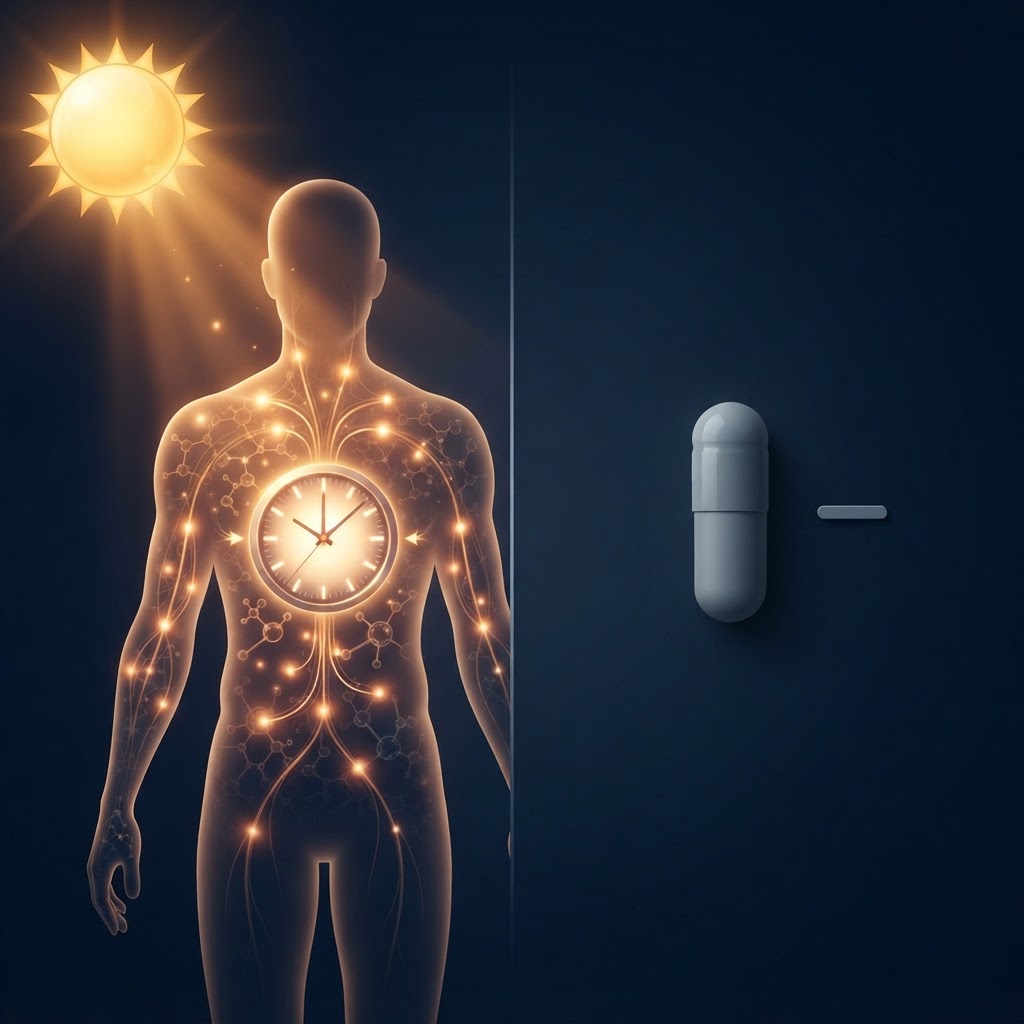
Vitamin D and the circadian rhythm: the sun interacts with the biological clock, the capsule remains silent.
Michael Holick built the global vitamin D capsule empire. Russell Reiter founded melatonin studies half a century ago. On December 31, 2025, both co-authored the same paper in the FASEB Journal, and that paper clearly establishes the distinction this blog has been working on for years: in the relationship between vitamin D and circadian rhythm, the only two molecules for which there is NO evidence of circadian regulation are precisely those involved in oral supplementation. The sun delivers a system coupled to biological time. The capsule delivers two molecules that have never shown any knowledge of that conversation.
WHO IS MICHAEL HOLICK: HE DISCOVERED THE SUN FACTORY AND SOLD THE CAPSULE
We're talking about a research giant, and it needs to be said right away, so that the following facts should be read with the rigor one uses with facts, not with a taste for revenge.
In 1980, his group demonstrated in Science how human skin synthesizes previtamin D3 from 7-dehydrocholesterol exposed to UVB (Holick MF, et al. “Photosynthesis of previtamin D3 in human skin and the physiological consequences.” Science. 1980;210:203-205. PMID 6251551). This discovery founded the photobiology of vitamin D: Holick knows the solar factory better than anyone else in the world.
But then he built the industry that replaced that factory. Sales of vitamin D supplements in the United States reached $936 million in 2017, a ninefold increase in the space of a decade, driven in part by the blood tests he himself had helped popularize (data: KFF Health News, 2018). The KFF Health News investigation calls him "the doctor responsible for turning the sunshine supplement into a billion-dollar behemoth" between sales and tests (Liz Szabo, "The Man Who Sold America on Vitamin D, and Profited in the Process", August 20, 2018. Source: https://kffhealthnews.org/aging/how-michael-holick-sold-america-on-vitamin-d-and-profited/ ). The New York Times, two days earlier, had headlined: "Vitamin D, the Sunshine Supplement, Has Shadowy Money Behind It" . The sun supplement has shady money behind it (The New York Times, August 18, 2018).
Accuracy is required, because we're talking about a living scientist: the billions are from the market, not his bank account. His documented earnings are something else: his consulting work for Quest Diagnostics, the company that performs vitamin D tests, has been ongoing since 1979, with a reported fee of $1.000 per month (2018 data); and $150.000 from the UV Foundation, the nonprofit arm of the then Indoor Tanning Association, paid to Boston University between 2004 and 2006 for his research. In all, the investigation states, "hundreds of thousands of dollars" from the vitamin D industry. Holick has always stated that the fees have never influenced his clinical opinion.
There's also a documented academic cost: in 2004, Barbara Gilchrest, chair of the department of dermatology at Boston University, asked him to leave the department because of his ties to the tanning lamp industry. Holick had called tanning lamps a "recommended source" of vitamin D "when used in moderation ." The International Agency for Research on Cancer classified them as carcinogenic to humans in 2009. Holick remained a professor of endocrinology.

A necessary clarification, because the confusion here is convenient for many: the sunscreens mentioned above are the cosmetic tanning machines found in beauty salons, almost all of which are predominantly UVA, the type classified by the IARC as carcinogenic to humans in 2009. They have nothing to do with narrow-band UVB phototherapy (UVB-NB, 311-313 nm), used in clinical dermatology for decades, dosed, certified as an electromedical device, and monitored by a doctor: two tools that share only three letters of the alphabet. The first is used to beautify oneself at risk; the second is used to deliver photons that the skin can read, without the tanning component that weighs down the budget. When this blog talks about light as an alternative to the sun, it's talking about the latter, not the beauty salon tanning bed.
There's an institutional response, and that's also documented: the Endocrine Society has since tightened its rules on conflicts of interest, and KHN asked Christopher McCartney, chair of the guidelines subcommittee, for his opinion. The answer is blunt: the current rules would not allow the chair of the guidelines committee to have financial conflicts.
Now reread the opening of this article. On December 31, 2025, this same scientist, along with the father of melatonin studies, co-signed a paper containing a sentence the empire had never seen written.
WHAT THE PAPER SAYS ABOUT VITAMIN CIRCADIAN RHYTHM
The title is already a question: “Is Vitamin D Signaling Regulated by and Does It Regulate Circadian Rhythms?” (Slominski AT, Slominski RM, Kamal M, Holick MF, Tuckey RC, Reiter RJ, Li W, Jetten AM. FASEB Journal. 2025;39(24):e71321. PMID 41396154. DOI 10.1096/fj.202503003R). First rule of reading, as engineers: it is a HYPOTHESIS paper , built on molecular modeling and literature synthesis, not a new experimental study. And it should be read with the verbs of the paper, which are prudent: “can”, “by deduction”, “hypothesis to be validated”.
What this clock is, in a few words: the circadian rhythm is maintained by a small group of genes that turn on and off in rotation every twenty-four hours. At the heart of the circuit are BMAL1 and CLOCK, which in turn are turned on by RORs and off by REV-ERBs, precisely by binding RORE elements in their promoters. Sleep, hormones, temperature, and blood pressure depend on this circuit: the basic musical score of biology. This is why the relationship between vitamin D and the circadian rhythm is fundamentally determined here.
That said, the central distinction is there, black on white, with the verbs faithful to the abstract:
A. Current evidence does NOT support a circadian regulation of 25(OH)D3 and 1,25(OH)2D3 production. These are, precisely, the two forms that are of interest in oral supplementation of industrial cholecalciferol.
B. There is, however, experimental and molecular evidence that the circadian network CAN regulate the activity of CYP11A1 and, BY INFERENCE, the downstream production of hydroxylated D3 derivatives.
C. These hydroxylated derivatives act as inverse agonists on RORα and RORγ and as agonists on AhR; molecular modeling also suggests that they act as agonists on RORβ and REV-ERB. ROR and REV-ERB regulate the transcription of several clock genes by binding to RORE response elements in their promoters.
D. There's also an indirect pathway: D3 derivatives can affect the clock via systemic melatonin levels. Signed Reiter: melatonin is the key in this field.

Vitamin D and circadian rhythm: Overview of sun photoproducts and two capsule forms
The paper's conclusion is exemplary in its honesty: "These hypotheses remain to be validated experimentally ." No one here has demonstrated that the capsule disrupts circadian rhythms: the paper doesn't say so, and neither do I. The paper says something more subtle, and larger, than this: the molecular family produced by the sun is structurally linked to clock receptors; the two molecules in the capsule, so far, have shown no such thing. Anyone who asks whether supplementation could be harmful is asking a question. Questions aren't data. The data here are these.
WHY THE PAPER WEIGHS ON THE CIRCADIAN RHYTHM: THE PACKAGE AGAINST THE TWO MOLECULES
Here's my opinion, embedded in the flow of data because they are inseparable. Cholecalciferol is a drug, not a supplement ( https://www.evolutamente.it/la-vitamina-d-colecalciferolo-e-un-farmaco-e-non-un-integratore/ ), it is obtained through industrial processes from sheep lanolin, and the same molecules are used to poison mice ( https://www.evolutamente.it/la-vitamina-de-veleno-per-topi-approfondimento-sul-colecalciferolo/ ). The sun, we have written and rewritten, is not a factory of a single vitamin: it is a package of signals, previtamin D3, lumisterol, tachysterol, CYP11A1 metabolites, which this blog has been describing since before FASEB Journal called it a “hypothesis” ( https://www.evolutamente.it/come-alzare-la-vitamina-d-domanda-sbagliata/ ).
The connection that completes the mosaic comes from Richard Weller, a dermatologist at the University of Edinburgh: in the August 2024 issue of the Journal of Investigative Dermatology, he wrote a title that speaks volumes: “Sunlight: Time for a Rethink?” (Weller RB. J Invest Dermatol. 2024;144(8):1724-1732. PMID 38661623). Weller has been documenting for years that the sun acts through pathways independent of vitamin D, from nitric oxide onwards, and that oral supplementation shows little benefit in large studies. The FASEB paper adds the missing piece: the reason for that “little benefit” perhaps lies in the coupling with biological time that the capsule lacks. The sun enters the system with schedules, spectrum, and photoproducts; the capsule enters with two molecules and no clock. This is the new frontier of research on vitamin D and circadian rhythm: the question is no longer "how much is in your blood", it's "at what time and who do you talk to".
The practical consequence is the usual one, and the data dictates it: never put a pill and light on the same level. It's not a question of dosage, it's a question of architecture.
THE FINAL QUESTION: IS HOLICK BACKING DOWN?
This isn't a diagnosis, and it should be considered a question: is he changing his mind, like many of his colleagues? The data is there, and it's the only solid evidence: he authored a paper that places the capsule outside of the circadian rhythm. The rest is the question the data leaves open. Intentions aren't mentioned, they're expected.
I close with the definitive distinction, the one that remains when the article is finished: the test his empire has taught the world, blood 25(OH)D3, measures the silent molecule. It measures the two forms that have never been shown to communicate with the clock, and ignores the entire family of the sun that communicates with the clock. A rising number says nothing about the dialogue between vitamin D and the circadian rhythm: this blog has been saying so for years ( https://www.evolutamente.it/la-vitamina-d-non-e-una-vitamina-ma-una-tossina-una-sintesi/ ). Now, the Pope of vitamin D has also signed it, saying it with us. The capsule didn't want this paper. The sun, however, expected it.
Follow us on our Telegram channel: https://t.me/evolutamente
This article is the result of a collaboration between Angelo Rossiello and an advanced artificial intelligence. The scientific study and other references were provided by Angelo, who gave precise guidance on structure, tone, and objectives. The AI developed the draft, while Angelo reviewed and validated each scientific statement using a method he calls a "refinement loop."
Disclaimer: The information in this article is for educational purposes only and does not replace medical advice. The cited paper is a work of hypothesis: no statement in this text should be construed as clinical evidence, and nothing in it should be construed as therapeutic advice or advice against it.
REFERENCES (verified on October 9, 2026)
- Slominski AT, Slominski RM, Kamal M, Holick MF, Tuckey RC, Reiter RJ, Li W, Jetten AM. “Is Vitamin D Signaling Regulated by and Does It Regulate Circadian Rhythms?” FASEB Journal. 2025;39(24):e71321. PMID 41396154. DOI 10.1096/fj.202503003R.
- Slominski AT, Kim TK, Janjetovic Z, Slominski RM, Li W, Jetten AM, Indra AK, Mason RS, Tuckey RC. “Biological Effects of CYP11A1-Derived Vitamin D and Lumisterol Metabolites in the Skin.” J Invest Dermatol. 2024;144(10):2145-2161. PMID 39001720. DOI 10.1016/j.jid.2024.04.022.
- Weller RB. “Sunlight: Time for a Rethink?” J Invest Dermatol. 2024;144(8):1724-1732. PMID 38661623. DOI 10.1016/j.jid.2023.12.027.
- Holick MF, MacLaughlin JA, Clark MB, et al. “Photosynthesis of previtamin D3 in human skin and the physiological consequences.” Science. 1980;210:203-205. PMID 6251551.
- KFF Health News (Liz Szabo). “The Man Who Sold America on Vitamin D, and Profited in the Process.” August 20, 2018. Source: https://kffhealthnews.org/aging/how-michael-holick-sold-america-on-vitamin-d-and-profited/
- The New York Times. “Vitamin D, the Sunshine Supplement, Has Shadowy Money Behind It.” August 18, 2018.
Fact check complete. The substance is solid: all data, PMIDs, DOIs, and citations match verified sources . Your additions (the UVB-NB clarification, the subtitle, "industrial cholecalciferol" at point A, "backtracking") are fine. Then there's a word that needs to be restored, the usual ALT repertoire, and a technical problem with the schema.
VERIFIED ✓
- FASEB paper: complete and exact citation (39(24):e71321, PMID 41396154, DOI 10.1096/fj.202503003R), faithful verbs (“can”, “by deduction”, “hypothesis to be validated”), intact AD list
- Weller: 2024;144(8):1724-1732, PMID 38661623 ✓; Holick 1980: PMID 6251551 ✓
- KHN numbers all correct: $936 million (2017), Quest 1979 at $1.000/month, UV Foundation $150.000 (2004-2006), Gilchrest 2004, IARC 2009, McCartney, NYT “Shadowy Money”
- Clarification on tanning lamps vs. UVB-NB: inserted, unassailable ✓
- Keyphrase in the first paragraph and in 2 H2s; metatitle (53 characters, keyphrase at the beginning), 129 metadescriptions, slug, 12 tags, 4 active internal links, linked KHN, claim and disclaimer ✓; 6 complete references ✓


